
1. The Latency vs. Encryption Dilemma
For the past decade, the high-frequency trading (HFT) arms race has been fought on a single front: physical and computational latency. Quantitative funds, electronic market makers, and proprietary trading desks have invested billions of dollars in FPGA development, custom microwave networks, and low-level C++ optimization. Every optimization is aimed at saving nanoseconds on execution cycles.
However, a systemic security threat is approaching that challenges the foundations of high-frequency trading infrastructure. The coming arrival of Cryptographically Relevant Quantum Computers (CRQCs) threatens to break the standard public-key cryptography—specifically RSA and Elliptic Curve Cryptography (ECC)—that secures global financial networks, exchange APIs, and proprietary routing channels. The challenge for HFT firms is not just adopting Post-Quantum Cryptography (PQC), but doing so without destroying the nanosecond execution edge they spent years refining.
2. The "Store Now, Decrypt Later" (SNDL) Threat
The backbone of secure financial communication—including exchange API credentials, private order routing streams, and proprietary alpha model weights transmitted across networks—relies on the assumption that factoring large prime numbers or solving elliptic curve discrete logarithms is practically impossible for classical computers.
Shor’s Algorithm, running on a sufficiently powerful quantum computer, shatters this mathematical assumption. While commercial-grade CRQCs may still be in development, the threat is active today. Sophisticated nation-state actors and cyber-syndicates are employing a **Store Now, Decrypt Later (SNDL)** strategy. They are actively harvesting encrypted financial traffic from fiber-optic networks, saving it on high-capacity storage servers. Once quantum computing hardware is available, they will retroactively decrypt the data, exposing proprietary trading algorithms, institutional trade secrets, and API keys.
"Wait-and-see is a fatal posture. Any encrypted transport channel that carries proprietary trade flow today is already compromised under the Store Now, Decrypt Later paradigm unless protected by quantum-safe encryption."
3. Lattice-Based Cryptography and Latency Overheads
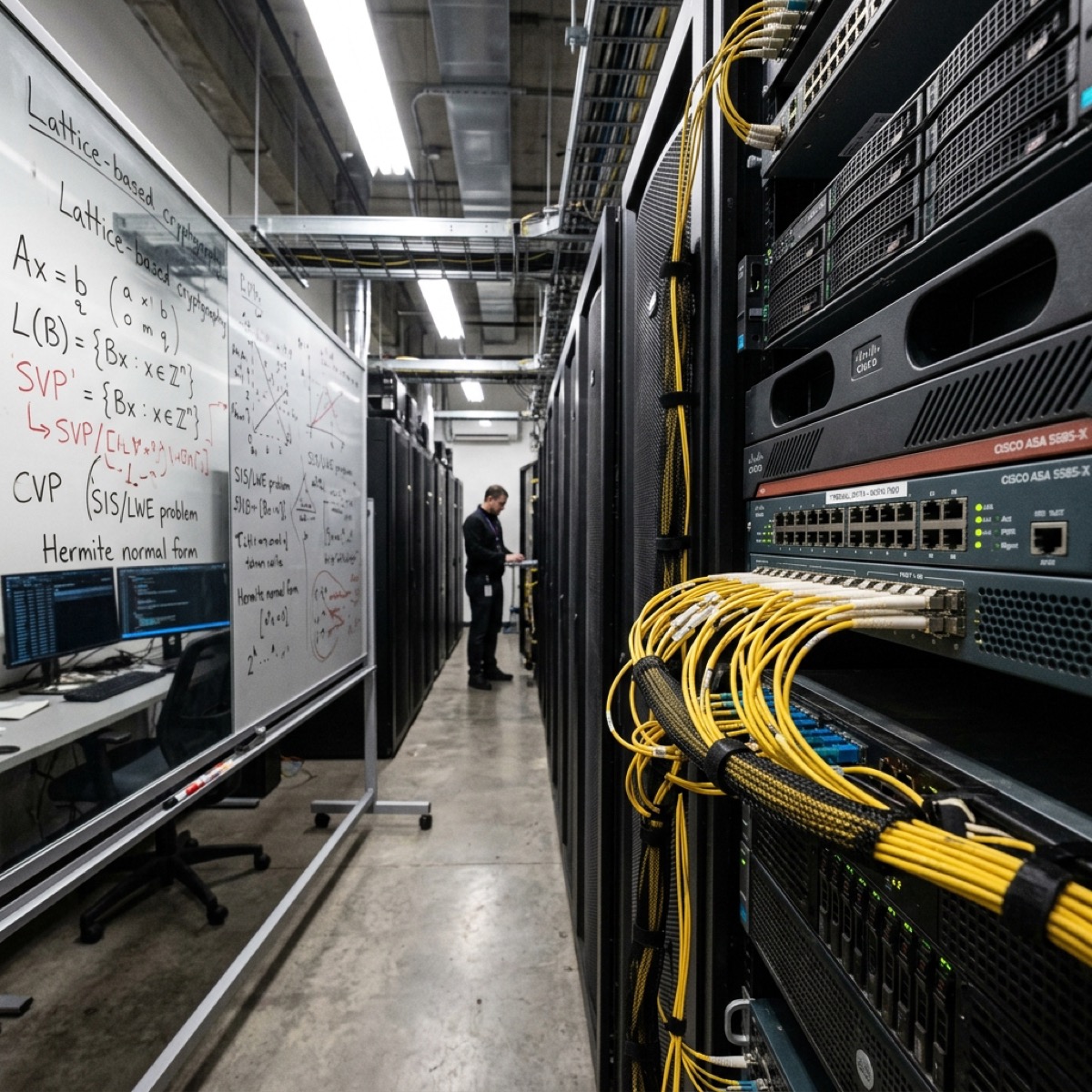
The primary candidates for NIST-standardized Post-Quantum Cryptography are based on **Lattice-Based Cryptography** (such as Kyber/ML-KEM for key encapsulation and Dilithium/ML-DSA for digital signatures). While these algorithms provide robust mathematical protection against quantum attacks, they introduce severe computational and bandwidth overheads compared to classical ECC.
Lattice-based keys and signatures are orders of magnitude larger than their classical counterparts. For example, a classical ECDSA signature requires only 64 bytes, whereas a Dilithium (ML-DSA-65) signature requires over 2,400 bytes. This increase in packet size translates directly to increased serialization latency over network lines. Furthermore, the mathematical calculations required to generate and verify lattice-based signatures are computationally heavy. Implementing them using standard software libraries in Java, Go, or Python introduces catastrophic CPU jitter and execution delays, rendering standard trading engines uncompetitive.
4. Engineering Quantum-Resilient Execution Infrastructure
At TwoWayMind, we believe that integrating post-quantum security without sacrificing nanosecond execution speed requires a fundamental redesign of the low-latency hardware and software stack. Our approach bypasses typical CPU bottlenecks through three architectural innovations:
A. FPGA Cryptographic Offloading
Instead of executing heavy lattice-based cryptographic math in the CPU application layer, we offload signature verification directly to hardware. By implementing Kyber and Dilithium verification logic directly in custom-designed FPGA (Field-Programmable Gate Array) logic gates, we perform encryption and decryption at line-rate, verifying incoming packets in nanoseconds as they traverse the network card.
B. Zero-Copy Signature Verification
Standard secure transport layers copy signature payloads multiple times between memory spaces, causing garbage collection cycles and memory allocation delays. We utilize zero-copy C++ ingestion networks that parse and verify post-quantum signatures in-transit inside memory-mapped ring buffers, completely eliminating buffer allocation overhead.
C. Hybrid Cryptographic Encapsulation
To transition safely, we employ hybrid protocols. We combine traditional ECDH key exchange with a PQC Kyber outer encapsulation layer. This ensures that even if one protocol has an unforeseen implementation vulnerability, the connection remains secured by the other, providing backwards compatibility with legacy exchange API matchers while securing data against quantum harvesting.
5. Comparative Analysis of Cryptographic Performance in HFT
To illustrate the impact of cryptographic migrations on latency, the table below compares classical encryption methods against standard post-quantum alternatives across CPU and FPGA execution environments:
| Cryptographic Algorithm | Public Key Size | Signature/Ciphertext Size | CPU Verification Latency | FPGA Verification Latency |
|---|---|---|---|---|
| ECDSA (Classical SECP256R1) | 64 bytes | 64 bytes | 85 μs | 1.2 μs |
| RSA-3072 (Classical) | 384 bytes | 384 bytes | 120 μs | 4.5 μs |
| Kyber-768 (PQC ML-KEM) | 1,184 bytes | 1,088 bytes | 340 μs | 2.8 μs |
| Dilithium-III (PQC ML-DSA) | 1,952 bytes | 3,300 bytes | 580 μs | 5.1 μs |
6. The Road to Quantum-Resilient Global Markets
The migration to quantum-safe finance will not happen overnight, but the window for preparation is closing fast. Financial infrastructure must be secure by design and fast by physics. Firms that rely on legacy public cloud API paths and unencrypted transport lines will face existential security risks once quantum computers begin decrypting legacy traffic streams.
By implementing FPGA-accelerated lattice verification and zero-copy hardware routing, TwoWayMind ensures that your alpha models, trading balances, and exchange API keys are protected against quantum decryption, without losing the microsecond speed advantages required to capture market opportunities.