
1. The Problem of Fragmented Liquidity
The financial markets of the 21st century look nothing like the centralized exchanges of the past. Today, liquidity is severely fragmented across primary exchanges, dark pools, alternative trading systems (ATS), and decentralized finance (DeFi) protocols. This fragmentation creates a unique challenge for algorithmic trading strategies.
When a quantitative model identifies a trading signal, the required liquidity to execute the position is rarely available on a single venue. A 1,000-lot order might need to be split across five different exchanges to minimize market impact. However, the moment the first slice of that order is filled, high-frequency trading (HFT) firms detect the footprint and pull their liquidity from the other four venues. This is the core problem of modern market microstructure.
Toxic liquidity refers to resting limit orders that belong to latency-arbitrageurs. If your routing system is too slow, you will only get filled when the market is moving against you (adverse selection).
2. Standard REST and WebSocket APIs are Obsolete
Most retail traders and early-stage quant funds rely on standard REST APIs or WebSocket connections provided by exchanges. While convenient, these protocols are heavily penalized by software overhead:
| Protocol | Average Latency | Primary Issue |
|---|---|---|
| REST API | 50 - 200 ms | TCP Handshake overhead per request |
| WebSocket (JSON) | 5 - 20 ms | Heavy CPU serialization/deserialization |
| Hardware FIX / DPDK | < 10 microseconds | Zero-copy kernel bypass |
To eliminate JSON parsing overhead, TwoWayMind engineered a custom ingestion layer built entirely in C++, utilizing zero-copy networking architectures like DPDK (Data Plane Development Kit). This ensures that tick data moves from the network interface card (NIC) directly into the routing logic without waking up the operating system kernel.
3. The Role of Hardware Acceleration (FPGA)
Even highly optimized C++ code running on the fastest overclocked CPUs hits a physical limit. Software instructions must be sequentially fetched, decoded, and executed by a processor. In the world of nanosecond arbitrage, this sequential pipeline is a fatal bottleneck.
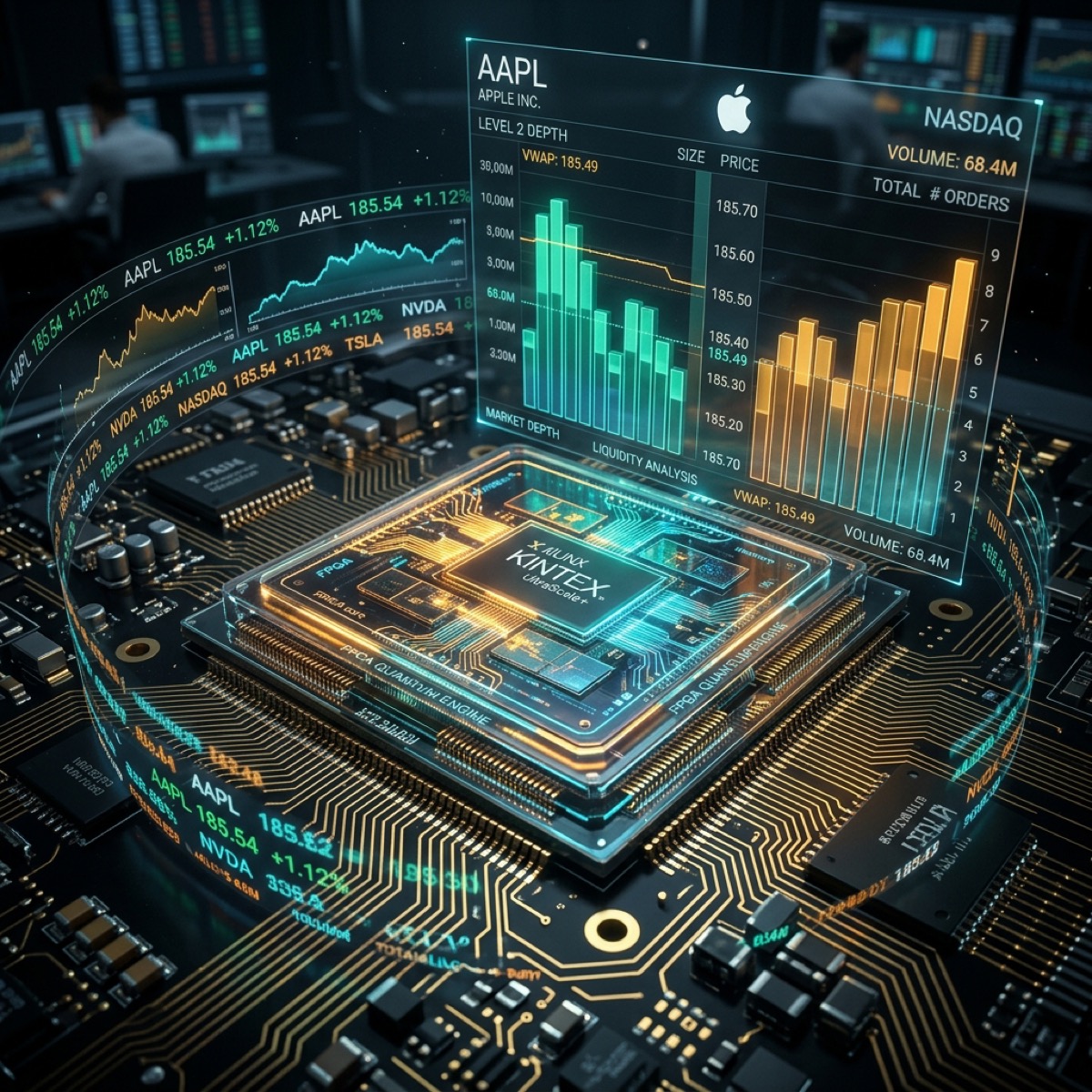
The solution is moving from software to hardware. Field-Programmable Gate Arrays (FPGAs) allow us to literally wire our trading logic into physical silicon circuits. When a network packet containing a price update arrives at the server, the FPGA doesn't "run code" to parse it. The electrical signals flow through a physical matrix of logic gates, determining the optimal routing decision at the speed of light.
- Parallel Processing: Unlike CPUs, FPGAs can process thousands of order book updates simultaneously without context switching.
- Deterministic Latency: Software suffers from jitter (unpredictable latency spikes due to garbage collection or OS interrupts). Hardware logic guarantees execution in the exact same number of clock cycles, every single time.
4. Smart Order Routing (SOR) in Action
How does all this technology come together in practice? Consider a scenario where our alternative data models generate a massive buy signal for a specific asset.
The TwoWayMind Smart Order Router (SOR) instantly calculates the optimal trajectory to absorb liquidity across multiple venues. Because our nodes are strategically colocated in AWS and GCP regions closest to the exchange matching engines, our routing logic calculates the geographic distance (speed of light in fiber optic cables) to each venue.
The SOR intentionally delays sending the order to the closest exchange (e.g., 2 milliseconds away) and fires the order to the furthest exchange (e.g., 10 milliseconds away) first. This ensures that all sub-orders arrive at the various exchange matching engines at the exact same nanosecond. HFT firms have no time to react and pull their liquidity.
Conclusion: Infrastructure is Alpha
Quantitative researchers often spend years tweaking hyperparameters in machine learning models, trying to squeeze out an extra 0.1% of predictive accuracy. However, in modern capital markets, the most beautiful mathematical model is useless without the infrastructure to execute it.
At TwoWayMind, we believe that infrastructure is the ultimate source of alpha. By combining zero-copy C++ architectures, strategic cloud colocation, and hardware-accelerated routing, we provide quantitative teams with the pristine market microstructure environment they need to succeed.