
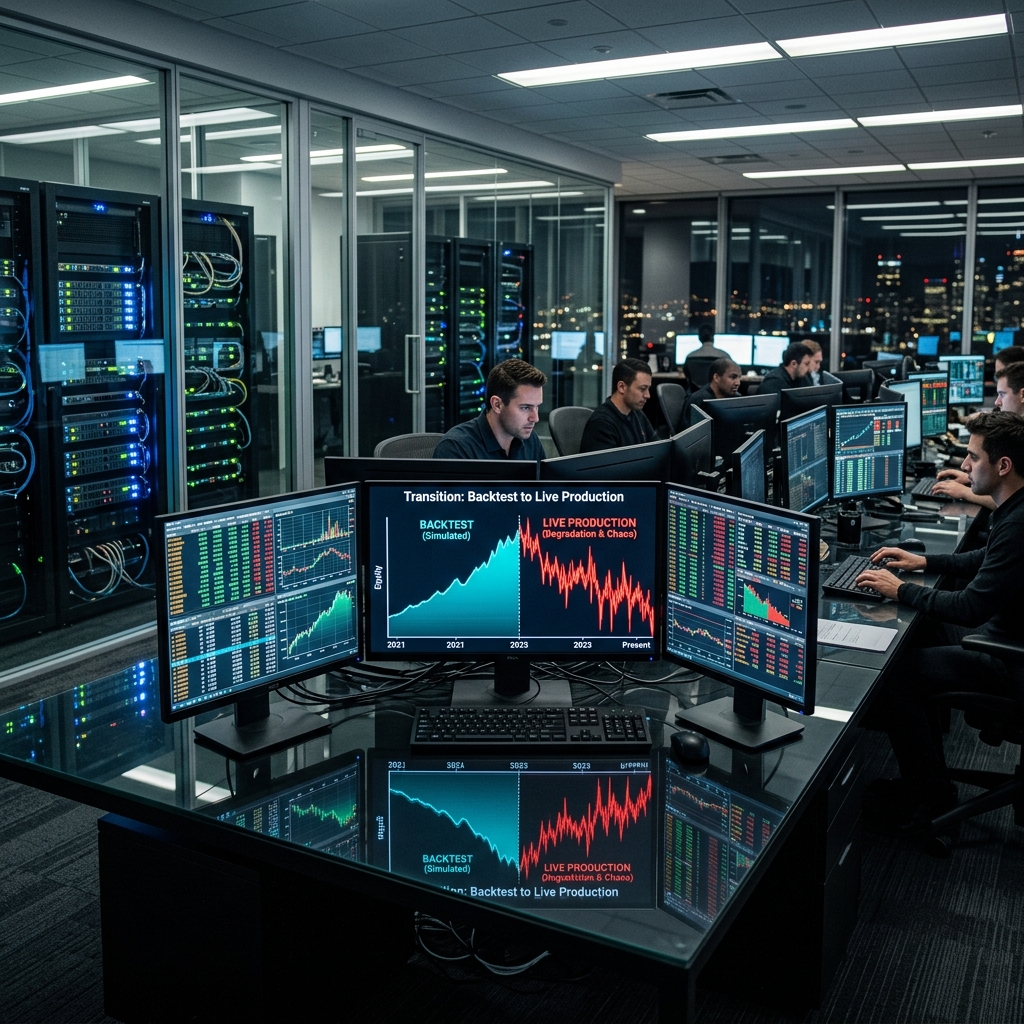
1. Introduction: The Beautiful Lie of the Equity Curve
It is a recurring tragedy on quantitative research desks worldwide. A researcher builds a new statistical arbitrage model. They backtest it against five years of historical tick data. The resulting equity curve is a perfectly smooth, 45-degree line pointing up and to the right, achieving a Sharpe ratio above 4.0 and drawdowns under 2%. Confident in their simulations, the team allocates institutional capital and deploys it live.
Within days, the model begins to bleed. The upward curve flattens and then rolls over into a steady decline. The math is double-checked and found to be flawless, the code is audited, and yet the discrepancy remains. The strategy is not suffering from a simple bug; it is suffering from the fundamental divergence between historical data simulation and live execution environment dynamics. The backtest was not a forecast; it was a beautiful, overfit lie.
2. The Mathematics of Backtest Overfitting (P-Hacking in Finance)
At the heart of simulation failure lies backtest overfitting, a statistical phenomenon closely related to p-hacking in scientific literature. When a quantitative researcher tests thousands of variations of a model on the same historical dataset—tweaking entry thresholds, parameter lookbacks, and stop-loss widths—they are conducting multiple testing. With enough iterations, it is mathematically guaranteed that one set of parameters will yield spectacular historical returns purely due to random chance.
This selection bias leads to models that have memorized the historical noise of the market rather than capturing true predictive signal. In statistics, this is measured using the False Discovery Rate (FDR). When a strategy is optimized across hundreds of assets and timeframes without correcting for the number of trials (such as utilizing the Bonferroni correction or the Deflated Sharpe Ratio proposed by Marcos López de Prado), the reported historical performance becomes mathematically meaningless for live forecasting.
"The more you search a dataset for a trading rule, the more likely you are to find one that is completely useless in production. If you test 1,000 random rules, the best one is guaranteed to look like a goldmine on paper."
3. Execution Friction: The Hidden Drain
Even if a model possesses a genuine mathematical edge, it must navigate the physical realities of execution. Most backtesting suites make a fatal simplification: they assume that if a price is printed in the historical tick log, an order could have been executed at that exact price. This ignores bid-ask spread friction, execution latency, and order book queue dynamics.
In real-world matching engines, orders are processed sequentially. If you submit a limit order at the current bid, you are placed at the back of the queue. On venues that utilize FIFO (First-In, First-Out) matching rules, your order may sit behind millions of dollars of institutional liquidity. If the market reverses, your order gets filled (adverse selection); if the market moves in your favor, the queue is cancelled before your order is reached. A backtest that assumes instant limit order fills at the historical price index will systematically overestimate returns, hiding a negative expected value behind simulated queue advantages.
4. Ghost Liquidity and Adversarial HFTs
In modern fragmented markets, liquidity is dynamic and adversarial. When an algorithm queries an exchange's public API and sees a specific volume available at a target price, it is observing what we call **ghost liquidity**. By the time the algorithm processes the signal and routes a market order, that liquidity has often vanished.
High-frequency trading (HFT) firms utilize collocated servers, proprietary microwave networks, and FPGA-based execution cards to monitor incoming order flows. If an HFT detects a large buy pressure routing through standard retail channels, it will instantly cancel its own limit sell orders on that venue and re-submit them at higher prices. Your algorithm is left chasing a target that moves faster than light, experiencing severe slippage that was completely unmodeled in your static simulation engine.
5. Comparative Analysis: Simulation vs. Live Production
To illustrate the wide gap between theoretical backtesting and production realities, we can compare the underlying assumptions that most simulation suites make versus the harsh physics of real execution venues:
| Market Parameter | Backtest Assumption | Production Reality |
|---|---|---|
| Execution Latency | 0 ms (Instantaneous execution) | 15 ms to 200 ms (API network jitter) |
| Liquidity Availability | Infinite at historical printed prices | Dynamic (HFTs cancel orders before you arrive) |
| Slippage Cost | Zero or static flat-rate assumption | Highly volatile and proportional to order size |
| Queue Priority | Instant fill upon price touch | FIFO order sequence (Frequent queue bypass) |
| Market Impact | Your trade doesn't change market price | Large orders shift the spread against you |
6. The TwoWayMind Mitigation Playbook: Bridging the Gap
Bridging the gap between backtesting and live production requires moving away from simplified simulators and adopting an infrastructure-first mindset. At TwoWayMind, we have spent years building a execution environment designed to eliminate simulation bias:
A. Adversarial Simulation Modeling
Rather than assuming perfect fills, our backtesting suite injects synthetic network jitter, packet drops, and dynamic order-book decay. By modeling the presence of hostile HFT participants that actively run ahead of large orders, we stress-test alpha models under worst-case liquidity scenarios before they touch real capital.
B. Sub-Millisecond C++ Execution Engine
Every microsecond spent parsing high-level code like Python or serialized JSON is a microsecond your competitors use to move the market. Our Smart Order Routing (SOR) engine is written entirely in optimized C++ with zero-copy memory layouts, ensuring that TradingView and API signals bypass bottleneck layers and hit the exchange matching engine with absolute minimal network latency.
C. Colocation and Direct Venue Routing
TwoWayMind deploys its core routing servers in the exact same infrastructure facilities (such as Equinix LD4 in London and global cloud servers near Bybit's matchers) that host top-tier institutional liquidity. This eliminates physical distance latency, protecting your entry prices from intermediate market front-running.
7. Conclusion
Quantitative finance is not merely a contest of mathematical intelligence; it is an engineering war. An elegant algorithm backed by slow execution will consistently lose to a simple strategy backed by sub-millisecond execution routing. To protect your capital from adverse selection and ghost liquidity, your development workflow must integrate execution realities from day one. By routing your models through TwoWayMind's low-latency execution pipes, you ensure that the alpha you discover in your research is the exact alpha you realize in production.